
Outdoor Almanacs The Forager's Almanac Free demo

Notion template · wild food & patches

Log the find.
Learn the patch.
Watch the season.

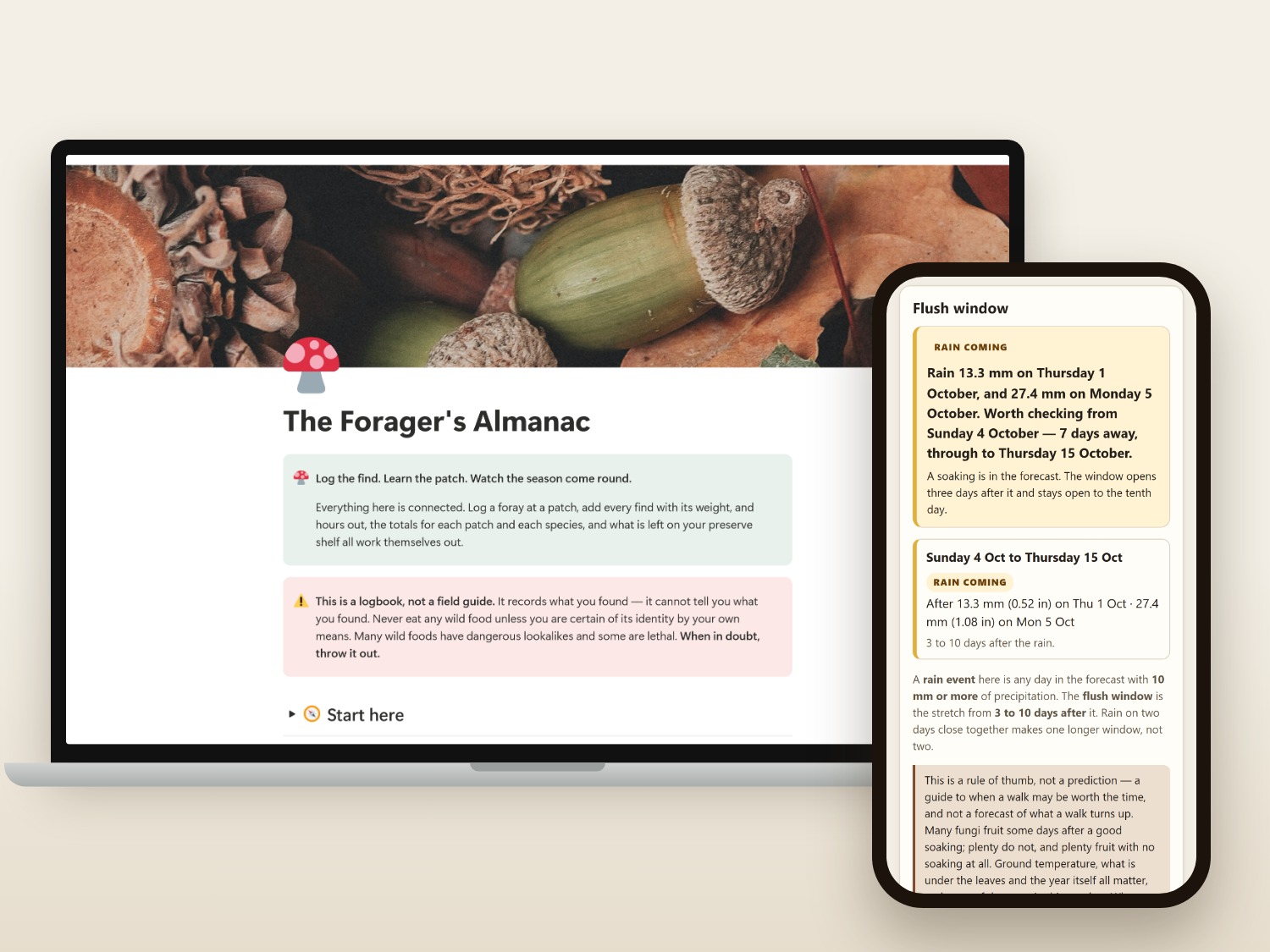
Log the find. Learn the patch. Watch the season come round. A private foraging logbook that lives in your own Notion: your patches stay yours, every find is dated and weighed, and opening a patch shows you the rain that has fallen, the flush window it opens, the next frost and how the day length is moving.

The Forager's Almanac Notion dashboard on a laptop, with a patch's rain and flush forecast on a phone

A logbook, not a field guide

Never eat any wild food unless you are certain of its identity by your own means. Some wild food is deadly. This template and its companion page identify nothing: they hold no species descriptions, no photographs to compare against, nothing on edibility or toxicity, and no assurance whatever about anything you bring home. They record what you found, where you found it, when, and what the weather was doing — and the identification is entirely yours, made by your own means before anything goes anywhere near a kitchen.

The rules are yours too. Permits, protected species, harvest limits, and permission to be on the land differ from one place to the next and change from year to year. Read and follow the rules for your own jurisdiction, and get the landowner's permission; none of that is written into this template, because none of it would be right for everyone who buys it.

The flush window after rain

A patch page leads with it: a day with 10 mm or more of rain in the forecast opens a window from 3 to 10 days after it. "Rain Tuesday, 14 mm. Worth checking from Friday." It is a rule of thumb about water and the calendar, not a prediction — and when no day reaches 10 mm it says so plainly instead of offering you a smaller number.

Frost, and the length of the day

A hard frost changes everything a patch is doing, so the next frost in the window is on the page: hard frost, frost or frost risk at 2 °C, from the same code the Gardener's Almanac uses. Under it, day length and whether it is lengthening or shortening — the marker that keeps its shape whatever a single week of weather does.

Finds you can actually look back on

Every find dated, weighed and tied to a patch, with your own notes and your own photographs. The template keeps the record; what you write in it is yours. After a few years of entries you are reading your own ground rather than anyone's chart.

Patches, kept to yourself

A patch is whatever you decide a patch is, with its own page, its own history and its own coordinates. They sit in your Notion and nowhere else. The patch page puts them in the address bar, sends them to the weather service and the map, and never writes them down.

The season, year on year

Last year's entries sit beside this year's, by patch and by week, with the rain and the temperatures that came with them. Nothing here tells you when anything happens; it shows you when it happened for you, which is the only version that is true.

Private by design

Foragers guard their patches, and this is built for that. Your patches, finds and photographs stay on your device and in your own Notion. The companion page has no accounts, no tracking and no analytics, and it never stores or logs a coordinate: they go to MET Norway for the forecast and to Esri for the map tiles, and nowhere else.

Free to try

See it with a sample patch

Open the page the template shows for a patch: the flush window and the rain that opened it, the next frost, day length and its direction, the forecast and a map.

The sample patch is a synthetic location, for demonstration only. Nothing grows there.

How it works

  1. Buy on Etsy and download the PDF.
  2. Open the template link inside it.
  3. Click Duplicate to copy the template into your own Notion.

You'll need a free Notion account. The template works on the free Notion plan, on desktop, in a web browser and in the Notion phone app, so you can log a find standing over it.

Questions

Will it tell me what I have found?

No, and it never will. There is no identification anywhere in this template or on its companion page: no species descriptions, no comparisons of one thing with another, no photographs to match against, nothing about edibility or toxicity. Wild food can kill, and a template sold to strangers is the wrong place for any of that. Learn identification from people and books that can be held to account for it, and be certain by your own means before you eat anything. What this gives you is a place to write down what you identified, and the conditions around it.

Does the flush window mean there is something to find?

No. It means enough rain has fallen that the days a flush often follows are the days ahead of you. It is a rule of thumb about water and the calendar — 10 mm or more in a day, then the stretch from three to ten days after it. Plenty of rain produces nothing, and plenty appears with no rain at all. Treat it as a reason to take the walk, never as a reason to expect a basket.

Why 10 mm, and why 3 to 10 days?

Because they are round, defensible numbers that the page states openly rather than hiding in a score. 10 mm in a day is a genuine soaking rather than a shower; three days is about the soonest a flush tends to follow one, and by the tenth day the window has stopped being useful. You can see the rain figures and the dates the window came from on the page and judge for yourself. When nothing in the forecast reaches 10 mm, the page says there is no soaking rain — it does not quietly drop the threshold to find you a window.

Does it tell me when to go, or where?

No. Seasons and habitats vary by region, by elevation, by the year and by the particular corner of bush you are standing in, and stating them as fact would be wrong for most of the people reading. The template is where your own records of both accumulate, from your own patches.

Will my patches stay private?

Yes, and this was the first thing designed. Patches, finds and photographs live in your own Notion. The patch page keeps its coordinates in the page address only: nothing is stored, nothing is logged, there is no analytics on the page, and the coordinates go to exactly two places — MET Norway for the forecast, and Esri for the map tiles. The page is also marked noindex and sends no referrer to other sites, so a patch link cannot turn up in a search engine or leak through a click.

What about permits, limits and protected species?

Those are yours to check and follow. They differ by country, province, state, park and woodlot, and they change. The template deliberately encodes none of them: it will not tell you a limit or that a place is open to you. Find out what applies where you are, get permission to be on the land, and record what you are allowed in your own copy.

Do I need a paid Notion plan?

No. Everything in the template works on Notion's free plan.

Does it work in °F and inches?

Yes. The patch page shows °C and °F, and rain in millimetres and inches, side by side.

Where does the forecast come from?

From MET Norway's weather model for the patch's coordinates. It covers about the next 9 days. Under a closed canopy or in a low hollow the ground can be doing something quite different, which is worth remembering every time the page shows you a number.

I'm stuck. How do I get help?

Send a message through Etsy and I'll help you sort it out.

Ready for the next walk?